
If you landed here looking for an intercom headset for a camera position, a front-of-house mix, or a stage crew, you may be wondering why a pilot shop is talking about pro audio.
Fair question. MyPilotStore is first and foremost an aviation dealer, but we have also been an authorized David Clark dealer for more than 25 years. David Clark builds a lot more than aviation headsets, and we stock most of what they make. Production companies, broadcasters, venues, and houses of worship buy the same green-domed headsets from us that pilots do, just with a different plug on the end.
This guide covers the full David Clark Pro Audio lineup, explains how the models differ, and helps you match a headset to your intercom.
TL;DR
- Every Series 8500 headset uses the same M-2H noise-cancelling microphone, the same gel ear seals, and the same rugged construction. Audio performance is essentially identical across the line.
- The models differ in only three ways: one ear or two, how the headset is worn, and which connector is on the cord.
- Check your beltpack or intercom station first. If it has a 4-pin male jack, you need a headset with a 4-pin female plug (H8532 or H8592). If it has a 4-pin female jack, you need a 4-pin male plug (H8535 or H8595).
- Anything else (5-pin, 6-pin, or a custom connector): buy the unterminated H8530 or H8590 and fit your own connector.
Who Uses David Clark Pro Audio Headsets?
Production teams know that clear communication is critical to performance. You will find David Clark Pro Audio headsets in sound studios, sporting arenas, concert venues, theaters, television studios, and at virtually any public or broadcast event.
Typical users and applications include:
- Front-of-house engineers
- Sound and lighting crews
- Camera and video operators
- Concert and touring production
- Industrial manufacturing
- Nuclear power plants
- Virtually any high-noise environment where people need to talk to each other
David Clark created the world’s first noise-attenuating communication headset, and the Pro Audio line is built on the same foundation as their aviation and ground support headsets: passive noise attenuation that protects your hearing, a microphone that rejects background noise, and hardware that survives years of being thrown in road cases.
What Every Series 8500 Headset Has in Common
Before getting into the differences, it helps to know how much these headsets share. Every Series 8500 model includes:
- M-2H dynamic noise-cancelling microphone for crisp, clear transmit audio
- Flex boom for easy, precise microphone placement
- Undercut Comfort-Gel ear seals that cradle the ear for long shifts
- Lightweight, low-tension hardware in carbon steel with a flat black finish
- Lightweight ABS composite ear domes
- Dynamic, moving-coil earphone elements (60 ohm each, 20 – 8,000 Hz)
- Around-the-ear (circumaural) passive noise attenuation. There are no batteries and no electronics to fail.
On the over-the-head and behind-the-head models, the boom rotates 280° so the microphone can be worn on the left or right side.
Because the microphone, earphones, and ear seals are the same across the line, you are not choosing between “good, better, best.” You are choosing the configuration that fits your job and your equipment.
Intercom Compatibility
The Series 8500 headsets are compatible with pro audio intercom systems from manufacturers such as:
- ClearCom
- Telex
- RTS
- HME
- Eartec
- Porta Phone
- Production Intercom
- ASL
- McCurdy
Intercom models vary, so always confirm the connector and pinout in your equipment’s manual before ordering.
Step 1: Match the Connector
This is the decision that matters most, because the wrong plug will not fit your equipment no matter how good the headset is.
| Your equipment has | Dual ear | Single ear |
|---|---|---|
| 4-pin male XLR jack | H8532 (over the head), H8542 (behind the head), H8570 (cap attachable) | H8592, DC 8692 (ultralight) |
| 4-pin female XLR jack | H8535 | H8595 |
| 5-pin, 6-pin, or anything else | H8530 (loose leads) | H8590 (loose leads) |
Remember that connectors mate with their opposite: a headset with a female plug connects to equipment with a male jack, and vice versa.
Step 2: One Ear or Two?
Dual-ear headsets cover both ears and carry a certified Noise Reduction Rating (NRR) of 23 dB (24 dB on the behind-the-head H8542). Choose dual ear for loud environments such as concerts, arenas, and industrial floors, or any time you need to hear the intercom clearly over the room.
Single-ear headsets leave one ear open so you can hear what is happening around you. That is useful for stage managers, camera operators, and anyone who needs to monitor the room and the intercom at the same time. They are also noticeably lighter, at just over 10 oz compared to roughly 14 oz for a dual-ear model.
Step 3: Pick a Wearing Style
- Over the head (OTH) is the standard configuration, with an adjustable headband spring and a soft foam head pad with a removable cotton cover.
- Behind the head (BTH) routes the spring behind your neck with an adjustable overhead support strap, leaving the top of your head clear for a hard hat or other protective headgear.
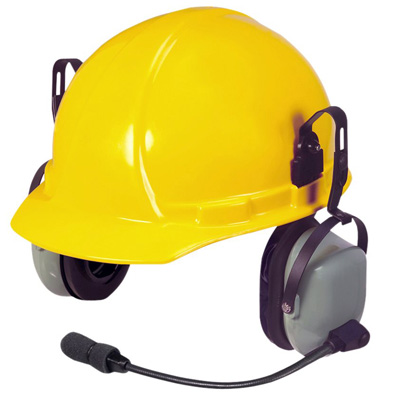
- Cap attachable mounts the ear cups directly to the side slots found on most safety headgear.
- Ultralight (ULW) is a rest-on-ear design for quieter environments where all-day comfort matters more than noise attenuation.
Dual-Ear Models
David Clark Series 8500 Dual-Ear Headsets
| H8530 | H8532 | H8535 | H8542 | H8570 | |
|---|---|---|---|---|---|
| Style | Over the head | Over the head | Over the head | Behind the head | Cap attachable |
| Connector | None (loose leads) | 4-pin XLR female | 4-pin XLR male | 4-pin XLR female | 4-pin XLR female |
| Cord | 5.67 ft straight | Coil, extends to 8 ft | Coil, extends to 8 ft | Coil, extends to 8 ft | Coil, extends to 8 ft |
| Earphone wiring | Separate channels | Parallel (mono) | Parallel (mono) | Parallel (mono) | Parallel (mono) |
| Volume controls | Dual | None | None | None | None |
| Certified NRR | 23 dB | 23 dB | 23 dB | 24 dB | Not published |
| Mic position | Left or right | Left or right | Left or right | Left or right | Left side |
| Works with hard hat | No | No | No | Yes | Yes |
| Weight (headset only) | 13.9 oz | 13.9 oz | 13.9 oz | 16.3 oz | 16.3 oz |
| DC part number | 40689G-02 | 40689G-01 | 40689G-03 | 40723G-01 | 40649G-03 |

David Clark H8532 Pro Audio Headset
SKU: 11-5313
The standard dual-ear intercom headset. Over-the-head style with a 4-pin female XLR on a coil cord that extends to 8 feet. Both earphones are wired in parallel for mono intercom audio. If your beltpack has a 4-pin male jack, this is the one to start with.

David Clark H8535 Pro Audio Headset
SKU: 11-5315
Identical to the H8532 in every respect except the connector: the H8535 has a 4-pin male XLR for equipment with a 4-pin female jack.

David Clark H8530 Pro Audio Headset
SKU: 11-5314
The flexible one. The H8530 ships with a 5.67-foot straight cord ending in prepared loose leads so you can install whatever connector your equipment requires. It is also the only model in the line with dual volume controls and earphones wired for separate channels, which makes it the choice for stereo or two-channel applications such as 5-pin camera intercoms.

David Clark H8542 Pro Audio Headset
SKU: 11-5319
The behind-the-head version of the H8532, for use with hard hats or other protective headgear. A reversible nape spring lets you wear the mic on either side, and an adjustable overhead support strap keeps it in place. 4-pin female XLR on a coil cord, with the highest NRR in the line at 24 dB.
David Clark H8570 Pro Audio Headset
SKU: 11-5320
Ear cups that attach directly to most safety headgear with side slots (headgear not included). Vertical-adjust stirrups let you dial in the fit for your particular hard hat. 4-pin female XLR on a coil cord, with the microphone dressed on the left side.
Single-Ear Models
David Clark Single-Ear Pro Audio Headsets
| H8590 | H8592 | H8595 | DC 8692 | |
|---|---|---|---|---|
| Style | Over the head | Over the head | Over the head | Over the head, ultralight |
| Connector | None (loose leads) | 4-pin XLR female | 4-pin XLR male | 4-pin XLR female |
| Cord | 5.67 ft straight | Coil, extends to 8 ft | Coil, extends to 8 ft | Approx. 5 ft straight |
| Ear coupling | Around the ear | Around the ear | Around the ear | On the ear |
| Ear seal | Comfort-Gel | Comfort-Gel | Comfort-Gel | Leatherette, memory foam |
| Hardware | Carbon steel | Carbon steel | Carbon steel | Lightweight alloy |
| Earphone impedance | 60 ohm | 60 ohm | 60 ohm | 1200 ohm |
| Earphone response | 20 – 8,000 Hz | 20 – 8,000 Hz | 20 – 8,000 Hz | 100 Hz – 15 kHz |
| Mic position | Left or right | Left or right | Left or right | Left or right |
| Weight (headset only) | 10.6 oz | 10.3 oz | 10.3 oz | 6.3 oz |
| DC part number | 40722G-03 | 40722G-01 | 40722G-05 | 43104G-04 |
All three H859x models add a dual-chamber temple pad on the open side to keep the headset stable and comfortable.

David Clark H8592 Pro Audio Headset
SKU: 11-5317
The single-ear counterpart to the H8532. Over-the-head style with a 4-pin female XLR on a coil cord. One ear on the intercom, one ear on the room.
David Clark H8595 Pro Audio Headset
SKU: 11-5318
The same headset as the H8592 with a 4-pin male XLR connector for equipment with a 4-pin female jack.

David Clark H8590 Pro Audio Headset
SKU: 11-5316
The unterminated single-ear model. A 5.67-foot straight cord with prepared loose leads lets you fit the connector your equipment calls for, and a single volume control lets you set your own listening level.
DC 8692 Ultralight
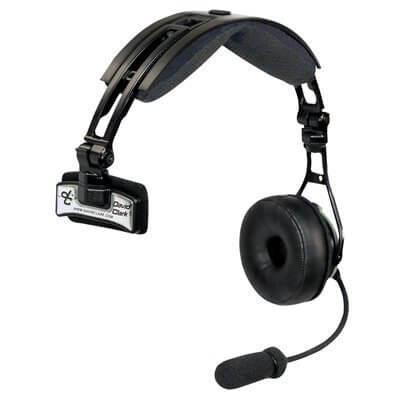
The DC 8692 is a different kind of headset. Where the H8500 models seal around the ear to block noise, the DC 8692 is a supra-aural (rest-on-ear) design intended for low-noise environments: studios, camera positions, training and simulation, tours, and work groups.
- Weighs just 6.3 oz, a little more than half the weight of the H8592
- Outlast technology head pad absorbs excess heat from the top of the head to eliminate hot spots
- Leatherette temple pad and ear seal with slow-recovery memory foam
- Magnesium alloy headband and suspension with swivel hinge stirrups for a fully adjustable fit
- The same M-2H noise-cancelling microphone on a full flex boom that rotates 280° for left or right wear
- 4-pin female XLR connector
David Clark DC 8692 Pro Audio Headset
SKU: 11-16328
If your crew wears a headset for an entire shift in a relatively quiet space, this is the comfortable option. Single ear, rest-on-ear design at just 6.3 oz, with a 4-pin female XLR connector.
Listen-Only: The 10S/DC Stereo Headset
Not everyone on the crew needs a microphone. The 10S/DC is a stereo, listen-only headset built on the same noise-attenuating platform, for monitoring a mix or program audio in a loud environment.

David Clark 10S/DC Pro Audio Headset
SKU: 11-5321
Dual-ear, over-the-head stereo headset with no microphone. Dual volume controls, undercut Comfort-Gel ear seals, a double-foam head pad, and a 23 dB NRR. The coil cord ends in a 3.5mm stereo plug, and both mono and stereo 1/4-inch adapters are included.
Complete Lineup at a Glance
| Model | Ears | Style | Connector | Datasheet |
|---|---|---|---|---|
| H8530 | Dual | Over the head | Loose leads | |
| H8532 | Dual | Over the head | 4-pin XLR female | |
| H8535 | Dual | Over the head | 4-pin XLR male | |
| H8542 | Dual | Behind the head | 4-pin XLR female | |
| H8570 | Dual | Cap attachable | 4-pin XLR female | |
| H8590 | Single | Over the head | Loose leads | |
| H8592 | Single | Over the head | 4-pin XLR female | |
| H8595 | Single | Over the head | 4-pin XLR male | |
| DC 8692 | Single | Over the head, ultralight | 4-pin XLR female | |
| 10S/DC | Dual | Over the head, listen only | 3.5mm stereo (1/4-inch adapters included) |
Frequently Asked Questions
What is an XLR connector?
XLR is a style of electrical connector found primarily on professional audio, video, and stage lighting equipment. The connectors are circular and have between 3 and 7 pins. Intercom headsets most commonly use the 4-pin version.
How do I find out which headset my equipment takes?
Equipment that is compatible with the David Clark Pro Audio headsets will have a four-pin male or female XLR connector. Choose the headset with the opposite gender.
If your equipment requires a different number of pins, use the H8530 (dual ear) or H8590 (single ear). These two models come with no connector attached. Purchase the correct mating XLR connector separately and attach it according to the pinout in your equipment’s user manual. A wiring diagram for the headset is included in the box.
How is a 4-pin XLR connector wired?
The 4-pin XLR is the standard connector for intercom headsets, including systems made by ClearCom and Telex. Two pins carry the mono headphone signal and two pins carry the unbalanced microphone signal. Pinouts vary between manufacturers and models, so consult your intercom’s documentation.
How is a 5-pin XLR connector wired?
5-pin XLR connectors are increasingly common on wireless beltpacks and cameras because they allow for a stereo headset. They typically use three pins for the stereo headphone signal (left, right, and ground) and two pins for the unbalanced microphone signal. Again, models vary, so check the manual.
The wires on the Series 8500 and 8600 headsets are color coded: red (hi) and white for the microphone, green (hi) and black for the earphones.
For a typical mono 5-pin camera pinout:
| Wire | 5-pin XLR |
|---|---|
| Red | Pin 2 |
| White | Pin 3 |
| Green | Pin 4 |
| Black | Pin 3 |
| Shield | Shield |
The stereo-capable H8530 includes additional conductors, yellow and blue, for the left earphone. For a typical stereo 5-pin camera pinout:
| Wire | 5-pin XLR |
|---|---|
| Red | Pin 2 |
| Yellow | Pin 4 |
| Green | Pin 5 |
| Blue, white, and black | Pin 3 |
| Shield | Shield |
How is a 3-pin XLR connector wired?
The 3-pin XLR is the standard balanced audio connector, although it is not what these headsets ship with:
- Pin 1: Chassis ground (cable shield)
- Pin 2: Positive polarity terminal for balanced audio circuits (“hot”)
- Pin 3: Negative polarity terminal for balanced circuits (“cold”)
Why does the M-2H microphone sound so much better?
The M-2H replaced the M-101 microphone used on earlier H8500 Series headsets. It is still a 150-ohm dynamic noise-cancelling element, so it works with the same equipment, but David Clark’s published figures show roughly twice the output level of the M-101 along with a wider frequency response. In practice that means a stronger, more natural-sounding voice on the intercom with less gain required.
What do the model numbers mean?
David Clark model numbers follow a pattern. The first character is usually a letter:
- H = Headset
- C = Cord, adapter, PTT adapter, or extension cord
- M = Module
- U = Utility intercom module
The first two digits identify the series, so an H8532 is a headset in the 8500 series. The second two digits describe the configuration:
| Model pattern | Configuration |
|---|---|
| Hxx10 and Hxx20 | Mic shield microphone |
| Hxx30 | Boom microphone, over the head |
| Hxx40 | Boom microphone, behind the head |
| Hxx50 and Hxx60 | Listen only, no microphone |
| Hxx70 and Hxx80 | Cap attachable or lightweight |
| Hxx90 | Single ear, over the head |
The last digit indicates a variant within that configuration. In the Pro Audio line it identifies the connector: the H8530 has loose leads, the H8532 has a female XLR, and the H8535 has a male XLR. The same pattern holds for the H8590, H8592, and H8595.
What do the abbreviations mean?
- OTH = Over the head
- BTH = Behind the head
- ULW = Ultra lightweight, single ear, over the head
- NRR = Noise Reduction Rating
Why Buy From MyPilotStore?
We have been an authorized David Clark dealer for more than 25 years, and we stock most of the David Clark catalog, including the Pro Audio line. We also carry replacement ear seals, head pads, microphones, and cords, so the headset you buy today can stay in service for a very long time. Our David Clark Headset Parts Finder covers the Pro Audio models along with everything else David Clark makes.
Not sure which connector you need, or outfitting an entire crew? We are happy to help.
Questions? Call us at 480-556-0500 or email [email protected]
Browse all David Clark Products at MyPilotStore.