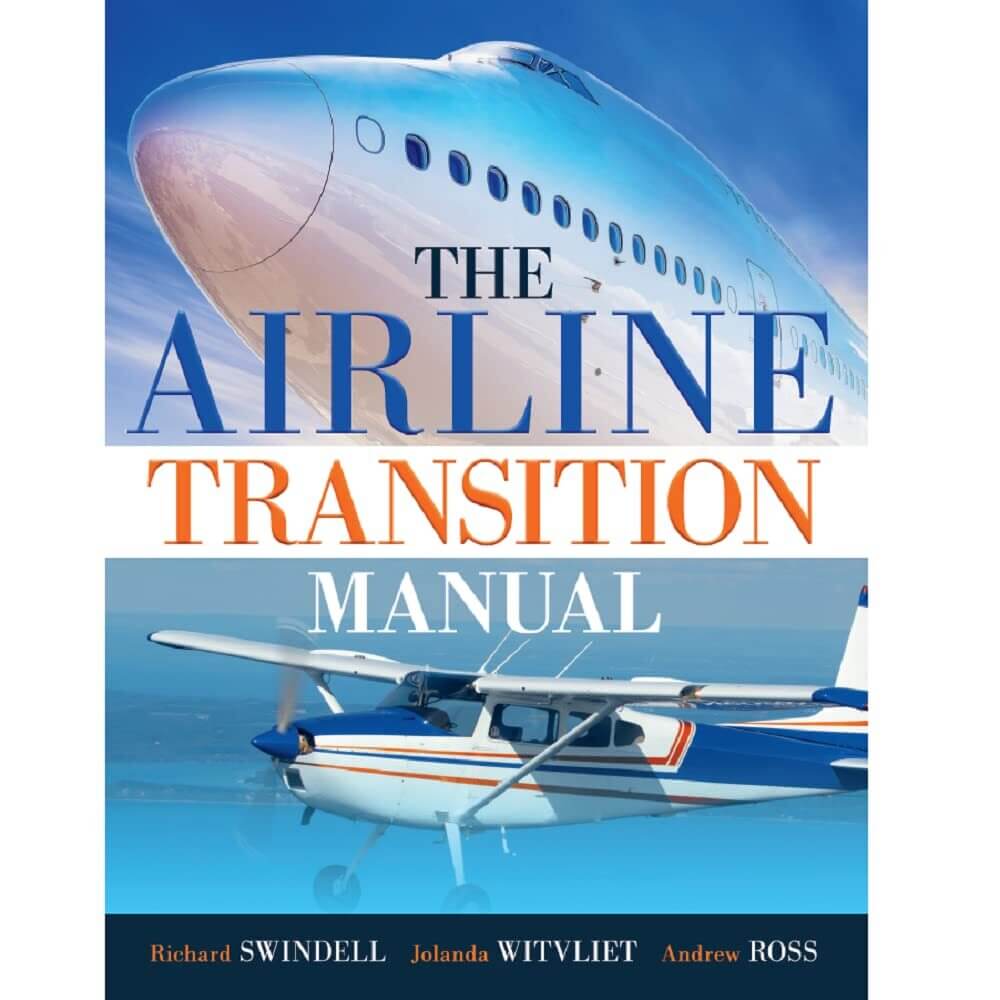
The Airline Transition Manual

    • List Price:  
    • Item #15572
    • PN: 9798985684506
  • List Price:  
  • Item #15572
Qty
alert

OUT OF STOCK - Expected Back Wednesday, June 10

You can place an order now and will ship as soon as it comes back in stock. You will NOT be charged until we are ready to ship your order and you can cancel at any time prior to shipment with no penalty. Your order is simply holding your place in line and all orders are filled on a first-come, first-served basis.

This manual is THE guide to preparing for an airline career!

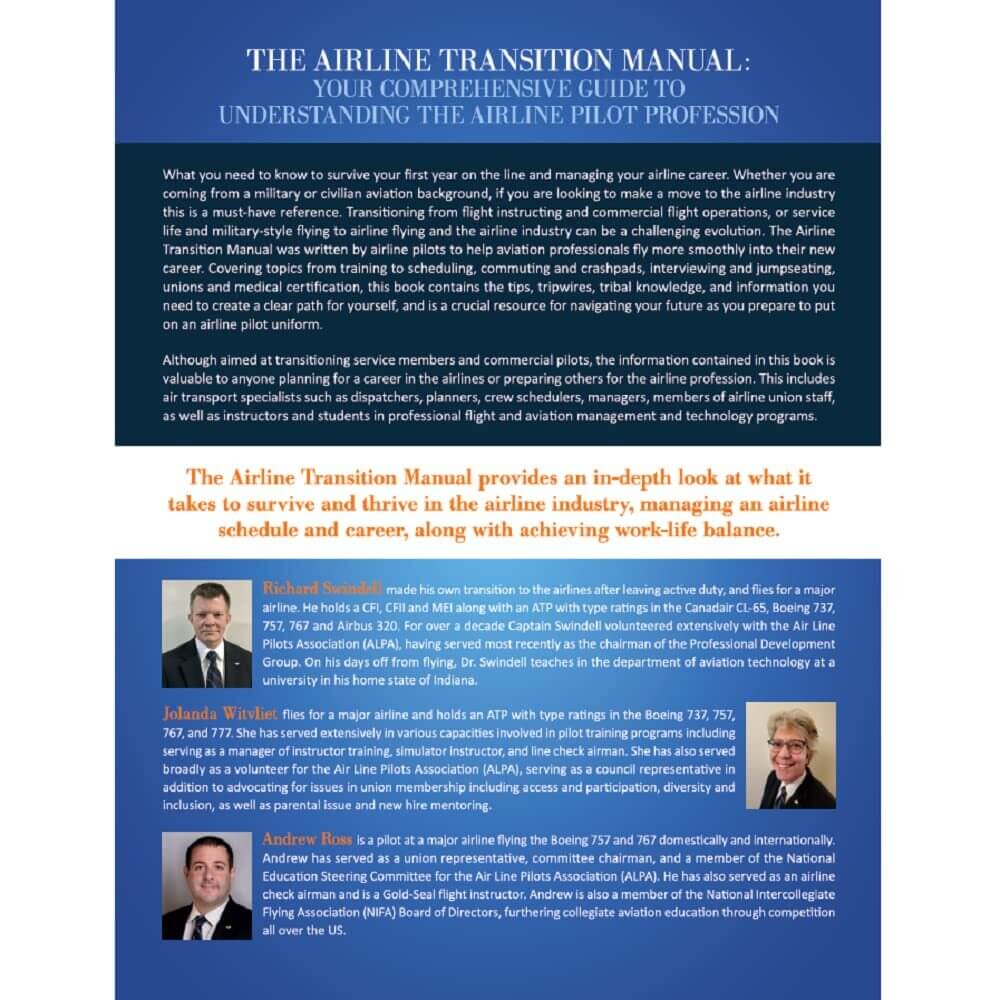
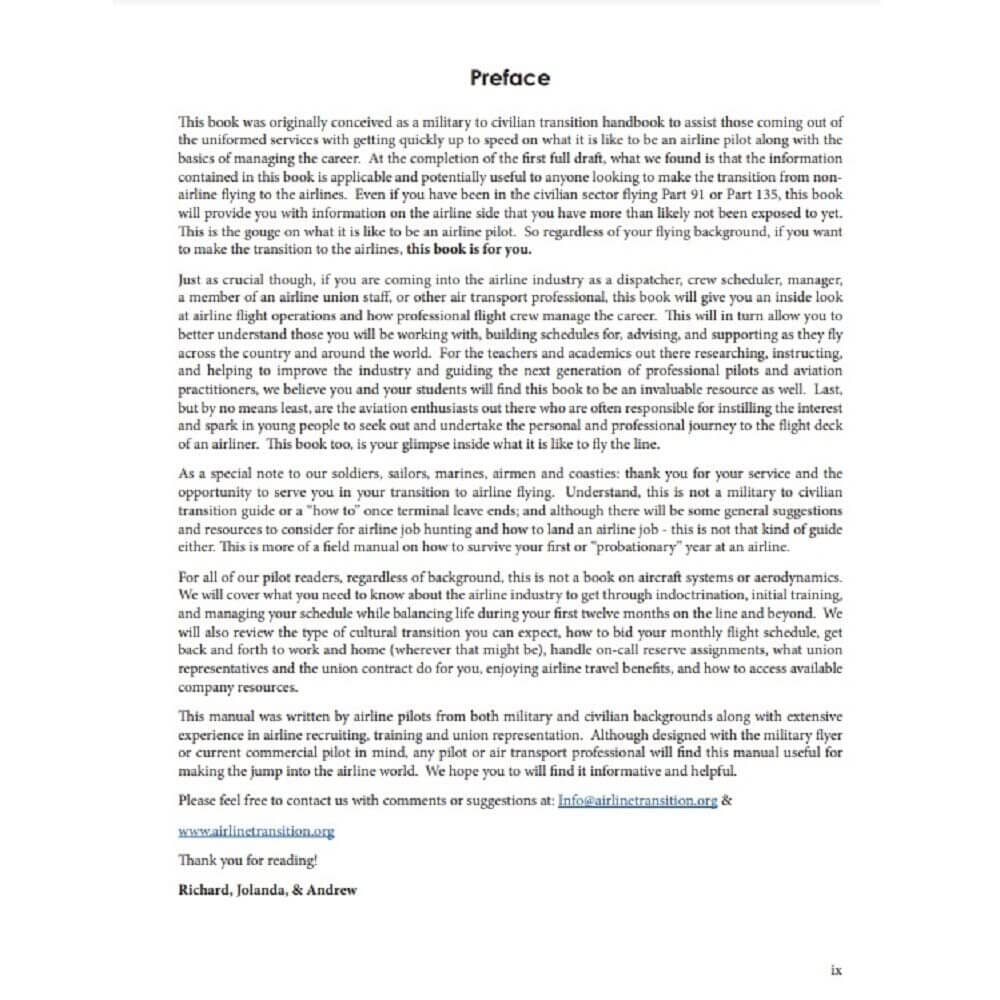
What you need to know to survive your first year, and beyond, on the line and managing your airline career. Whether you are coming from a military or civilian aviation background, if you are looking to make a move to the airline industry, this is a must-have reference. Transitioning from flight instructing and commercial flight operations, or service life and military-style flying to airline flying and the airline industry can be a challenging evolution. The Airline Transition Manual was written by airline pilots to help aviation professionals fly more smoothly into their new career.

Covering topics from training to scheduling, commuting to crashpads, interviewing and jumpseating, unions and medical certification, this book contains the tips, tripwires, tribal knowledge, and information you need to create a clear path for yourself, and is a crucial resource for navigating your future as you prepare to put on an airline pilot uniform.

Although aimed at transitioning service members and civilian pilots, the information contained in this book is valuable to anyone planning for a career in the airlines or preparing others for the airline profession. This includes air transportation specialists such as dispatchers, planners, crew schedulers, managers, members of airline union staff, as well as instructors and students in professional flight and aviation management and technology programs.

Take a look below and review the expanded Table of Contents.

Chapter 1: The Airline Industry - A Primer:
An overview of the airline industry structure including majors, regionals, cargo carriers, and overseas ex-pat flying, along with a short recap of the industry since 9/11 as well as projections for a post-coronavirus recovery.

Chapter 2: Work Life - What It’s Like to be an Airline Pilot:
What flying for an airline is really like – lineholders, reserves, airline structure and hierarchy, in addition to junior manning, senior manning, working with flight attendants and managing your quality of life.

Chapter 3: Airline Interviews - Getting to Know the Applicant:
Tips and tripwires along with what to expect when selling yourself during this meet and greet process and what the airlines are really looking for.

Chapter 4: Airline Indoctrination - Getting to Know the Company:
Meeting your employer, the union, and your new career.

Chapter 5: Training Survival - Running the Gauntlet:
Making it through the gauntlet of aircraft systems, simulator training, initial operating experience, line checks and recurrent training.

Chapter 6: Operational Knowledge - Airport, ATC, and Airline Operations:
A quick and easy gouge on airline, ATC, and airport operations including many major hubs, gate agents, maintenance, de-icing, what to do with ramp and metering, and a basic strategy for handling emergencies.

Chapter 7: Day 1 - Getting Started on the Line:
Building a mental checklist and prepping for your first trip on the line flying passengers or cargo, including meeting your line check pilot and making sure you have your uniform, flight kit, and a parking plan for your car.

Chapter 8: Aeromedical - Examiners, Medical Certificates, and Time Off:
An overview of FAA medical certificates, aeromedical examiners, health issues, company insurance plans, medical leaves of absences, and suggestions for maintaining your certificate.

Chapter 9: Alcohol and Drugs - How to Get in Trouble and Get Help:
Finding the balance and understanding the risks of substance abuse and dependency at the airlines, including over-the-counter sleep aids, along with getting the help you need to preserve your life, family, and career.

Chapter 10: Non-Working Travel - Jumpseating, Deadheading, and Non-Revving:
The how-to on getting to work and back home, including the differences between stand-by, positive space, deadheading, jumpseating, and non-rev travel, as well as the requirements, pay, and protocol associated with each.

Chapter 11: Navigating Reserve - On-Call for the Airline:
Sorting out long call, short call, field standby and how to deal with being on-call for the airline by understanding reserve rules and your contract.

Chapter 12: Bidding your Schedule - The Life Scheduling Process:
An introduction to the tools and software (whether using a preferential bidding system or line bidding system) used for generating monthly flight schedules, in addition to vacation, vacancies, displacements, and furlough.

Chapter 13: Sleep - An Airline Guide:
The chapter on where and how to afford getting some rest, including sleep rooms, hotels, crashpads, and what it means to be fatigued.

Chapter 14: Unions and Contracts - The What and Why of Organized Labor:
An introduction to the heavily unionized airline industry and what it means to work under the Railway Labor Act, a collective bargaining agreement, and as a member of an organized labor group.

Chapter 15: Federal Aviation Regulations (FARs) - What you Need to Know:
What you really need to know to help you through the first year or so at an airline, including highlights from FARs 61, 91, 121, and 117.

Chapter 16: Security - Law and Customs Enforcement in the Airline Industry:
DHS, CBP, TSA, KCM, and other security acronyms and agencies along with explanations (to the best of our ability) and recommendations for getting quickly through security and customs without running afoul of the law.

Chapter 17: Probation - Getting Through Your First Year:
Getting through the first year, including time off, sick calls, FMLA, MPLA, vacancy bids, upgrade, aircraft transition training, and more.

Chapter 18: Veterans Affairs - A Quick Reference for Service Members:
USERRA, VEVRAA, and things to think about when managing Guard and Reserve duty alongside an airline career.

Chapter 19: FAR Part 141 to Airline Transition - What Should I be Doing Now?:
A chapter dedicated to navigating the distance between college and the airlines, delivered in a Q&A format.

Chapter 20: Weekly Deployments - A Guide for Spouses and Significant Others:
A Guide for airline spouses, partners, significant others and family members dealing with their pilot being away from home for several days a week or longer.

Chapter 21: Transitioning to the United States - An Overview for Foreign Pilots and Students:
An Overview for Foreign Pilots and Flight Students: A resource for those considering training and working in the US, including certificate conversion, visas, and preparing yourself for the practical and cultural shift.

Chapter 22: The Contingency Plan - Being Prepared for Career Downturns:
Because this is a cyclical industry, this chapter encourages you to have a plan for when things in this industry don’t turn out like you want or expect them to.

Authors:
Jolanda Witvliet
is a published author and flies for a major airline and holds an ATP with type ratings in the Boeing 737, 757, 767, and 777. She has served extensively in various capacities involved in pilot training programs, including serving as a manager of instructor training, simulator instructor, and line check airman. She has also served broadly as a volunteer for the ALPA, serving as a council representative in addition to advocating for issues in union membership including access and participation, diversity and inclusion, as well as parental issues and new hire mentoring.

Richard Swindell made his own transition to the airlines after leaving active duty military service, and flies for a major airline. He holds an ATP certificate with type ratings in the Canadair CL-65, Boeing 737, 757, 767 and Airbus 320. For over a decade Captain Swindell volunteered extensively with the Air Line Pilots Association (ALPA), serving in multiple capacities including the national Professional Development Group Chairman, working to advance membership benefits, provide aviation educational outreach, assist veterans transitioning to airline flying, delivering union leadership training, and assisting with the furloughed pilot support network. On his days off from flying, Dr. Swindell teaches in the department of aviation technology at a university in his home state of Indiana. When he is not flying or teaching, Richard is an avid mountain biker.

Andrew Ross is a pilot at a major airline flying the Boeing 757 and 767 domestically and internationally. Andrew has served as a union representative, committee chairman, and is a member of the National Education Steering Committee for the ALPA. He has also served as an airline check airman and is a Gold-Seal Flight Instructor. Andrew is also a member of the National Intercollegiate Flying Association (NIFA) Board of Directors, furthering collegiate aviation education through competition all over the US. Andrew holds his masters degree in organizational leadership with a focus in non-profit management and executive coaching and counciling from Lewis University. He currently runs his own coaching and consulting firm. He is also a published author.

Lowest Price Guaranteed!

If you find a better price elsewhere on this product we will Match that price and beat it by 10% of the difference. See Details.

Buy with Confidence!

Purchase today and you can return it in the original condition through Tuesday, July 7, 2026!   See our return policy.

The Airline Transition Manual

  • List Price:  
  • Item #15572
  • PN: 9798985684506
Qty
alert

OUT OF STOCK - Expected Back Wednesday, June 10

You can place an order now and will ship as soon as it comes back in stock. You will NOT be charged until we are ready to ship your order and you can cancel at any time prior to shipment with no penalty. Your order is simply holding your place in line and all orders are filled on a first-come, first-served basis.

The Airline Transition Manual Overview:

This manual is THE guide to preparing for an airline career!

What you need to know to survive your first year, and beyond, on the line and managing your airline career. Whether you are coming from a military or civilian aviation background, if you are looking to make a move to the airline industry, this is a must-have reference. Transitioning from flight instructing and commercial flight operations, or service life and military-style flying to airline flying and the airline industry can be a challenging evolution. The Airline Transition Manual was written by airline pilots to help aviation professionals fly more smoothly into their new career.

Covering topics from training to scheduling, commuting to crashpads, interviewing and jumpseating, unions and medical certification, this book contains the tips, tripwires, tribal knowledge, and information you need to create a clear path for yourself, and is a crucial resource for navigating your future as you prepare to put on an airline pilot uniform.

Although aimed at transitioning service members and civilian pilots, the information contained in this book is valuable to anyone planning for a career in the airlines or preparing others for the airline profession. This includes air transportation specialists such as dispatchers, planners, crew schedulers, managers, members of airline union staff, as well as instructors and students in professional flight and aviation management and technology programs.

Take a look below and review the expanded Table of Contents.

Chapter 1: The Airline Industry - A Primer:
An overview of the airline industry structure including majors, regionals, cargo carriers, and overseas ex-pat flying, along with a short recap of the industry since 9/11 as well as projections for a post-coronavirus recovery.

Chapter 2: Work Life - What It’s Like to be an Airline Pilot:
What flying for an airline is really like – lineholders, reserves, airline structure and hierarchy, in addition to junior manning, senior manning, working with flight attendants and managing your quality of life.

Chapter 3: Airline Interviews - Getting to Know the Applicant:
Tips and tripwires along with what to expect when selling yourself during this meet and greet process and what the airlines are really looking for.

Chapter 4: Airline Indoctrination - Getting to Know the Company:
Meeting your employer, the union, and your new career.

Chapter 5: Training Survival - Running the Gauntlet:
Making it through the gauntlet of aircraft systems, simulator training, initial operating experience, line checks and recurrent training.

Chapter 6: Operational Knowledge - Airport, ATC, and Airline Operations:
A quick and easy gouge on airline, ATC, and airport operations including many major hubs, gate agents, maintenance, de-icing, what to do with ramp and metering, and a basic strategy for handling emergencies.

Chapter 7: Day 1 - Getting Started on the Line:
Building a mental checklist and prepping for your first trip on the line flying passengers or cargo, including meeting your line check pilot and making sure you have your uniform, flight kit, and a parking plan for your car.

Chapter 8: Aeromedical - Examiners, Medical Certificates, and Time Off:
An overview of FAA medical certificates, aeromedical examiners, health issues, company insurance plans, medical leaves of absences, and suggestions for maintaining your certificate.

Chapter 9: Alcohol and Drugs - How to Get in Trouble and Get Help:
Finding the balance and understanding the risks of substance abuse and dependency at the airlines, including over-the-counter sleep aids, along with getting the help you need to preserve your life, family, and career.

Chapter 10: Non-Working Travel - Jumpseating, Deadheading, and Non-Revving:
The how-to on getting to work and back home, including the differences between stand-by, positive space, deadheading, jumpseating, and non-rev travel, as well as the requirements, pay, and protocol associated with each.

Chapter 11: Navigating Reserve - On-Call for the Airline:
Sorting out long call, short call, field standby and how to deal with being on-call for the airline by understanding reserve rules and your contract.

Chapter 12: Bidding your Schedule - The Life Scheduling Process:
An introduction to the tools and software (whether using a preferential bidding system or line bidding system) used for generating monthly flight schedules, in addition to vacation, vacancies, displacements, and furlough.

Chapter 13: Sleep - An Airline Guide:
The chapter on where and how to afford getting some rest, including sleep rooms, hotels, crashpads, and what it means to be fatigued.

Chapter 14: Unions and Contracts - The What and Why of Organized Labor:
An introduction to the heavily unionized airline industry and what it means to work under the Railway Labor Act, a collective bargaining agreement, and as a member of an organized labor group.

Chapter 15: Federal Aviation Regulations (FARs) - What you Need to Know:
What you really need to know to help you through the first year or so at an airline, including highlights from FARs 61, 91, 121, and 117.

Chapter 16: Security - Law and Customs Enforcement in the Airline Industry:
DHS, CBP, TSA, KCM, and other security acronyms and agencies along with explanations (to the best of our ability) and recommendations for getting quickly through security and customs without running afoul of the law.

Chapter 17: Probation - Getting Through Your First Year:
Getting through the first year, including time off, sick calls, FMLA, MPLA, vacancy bids, upgrade, aircraft transition training, and more.

Chapter 18: Veterans Affairs - A Quick Reference for Service Members:
USERRA, VEVRAA, and things to think about when managing Guard and Reserve duty alongside an airline career.

Chapter 19: FAR Part 141 to Airline Transition - What Should I be Doing Now?:
A chapter dedicated to navigating the distance between college and the airlines, delivered in a Q&A format.

Chapter 20: Weekly Deployments - A Guide for Spouses and Significant Others:
A Guide for airline spouses, partners, significant others and family members dealing with their pilot being away from home for several days a week or longer.

Chapter 21: Transitioning to the United States - An Overview for Foreign Pilots and Students:
An Overview for Foreign Pilots and Flight Students: A resource for those considering training and working in the US, including certificate conversion, visas, and preparing yourself for the practical and cultural shift.

Chapter 22: The Contingency Plan - Being Prepared for Career Downturns:
Because this is a cyclical industry, this chapter encourages you to have a plan for when things in this industry don’t turn out like you want or expect them to.

Authors:
Jolanda Witvliet
is a published author and flies for a major airline and holds an ATP with type ratings in the Boeing 737, 757, 767, and 777. She has served extensively in various capacities involved in pilot training programs, including serving as a manager of instructor training, simulator instructor, and line check airman. She has also served broadly as a volunteer for the ALPA, serving as a council representative in addition to advocating for issues in union membership including access and participation, diversity and inclusion, as well as parental issues and new hire mentoring.

Richard Swindell made his own transition to the airlines after leaving active duty military service, and flies for a major airline. He holds an ATP certificate with type ratings in the Canadair CL-65, Boeing 737, 757, 767 and Airbus 320. For over a decade Captain Swindell volunteered extensively with the Air Line Pilots Association (ALPA), serving in multiple capacities including the national Professional Development Group Chairman, working to advance membership benefits, provide aviation educational outreach, assist veterans transitioning to airline flying, delivering union leadership training, and assisting with the furloughed pilot support network. On his days off from flying, Dr. Swindell teaches in the department of aviation technology at a university in his home state of Indiana. When he is not flying or teaching, Richard is an avid mountain biker.

Andrew Ross is a pilot at a major airline flying the Boeing 757 and 767 domestically and internationally. Andrew has served as a union representative, committee chairman, and is a member of the National Education Steering Committee for the ALPA. He has also served as an airline check airman and is a Gold-Seal Flight Instructor. Andrew is also a member of the National Intercollegiate Flying Association (NIFA) Board of Directors, furthering collegiate aviation education through competition all over the US. Andrew holds his masters degree in organizational leadership with a focus in non-profit management and executive coaching and counciling from Lewis University. He currently runs his own coaching and consulting firm. He is also a published author.


1 CUSTOMER REVIEWS

  • The Airline Transition Manual

    1 Reviews

  • Average Customer Review:

Filter

Select a row below to filter reviews by star rating.

Top Reviews
  • Verified Purchase

All-in-one info source

  • By A Customer on Sunday, January 19, 2025
  • Pros:
  • Review: Fantastic resource for anyone interested in the airlines, and particularly useful to military pilots like myself who are interested in jumping ship, but unsure of how airline jobs actually work (besides rumor). Answered all of the questions I was going to ask my friends that had already transitioned, plus another 1000 that I hadn't even thought of.

All-in-one info source

  • By A Customer on Sunday, January 19, 2025
  • Review: Fantastic resource for anyone interested in the airlines, and particularly useful to military pilots like myself who are interested in jumping ship, but unsure of how airline jobs actually work (besides rumor). Answered all of the questions I was going to ask my friends that had already transitioned, plus another 1000 that I hadn't even thought of.
  • Was this review helpful to you? Yes No 0 Other people found this review helpful.

0 QUESTIONS & ANSWERS

Customers who bought this also considered:

Lowest Price Guaranteed!

If you find a better price elsewhere on this product we will match that price and beat it by 10% of the difference.

Buy with Confidence!

Purchase today and you can return it in the original condition through Tuesday, July 7, 2026 !   See our return policy.

Sign up for our newsletter and stay updated on special offers.